Diagnosis of embankment hydraulic structures
Contact
✉️
The diagnosis of a hydraulic structure consists of an assessment of its condition to ensure its safety in the face of identified risks or its compliance with the regulatory framework. geophyConsult carries out diagnosis studies for embankment dams and dikes of all classes (A, B, C). With its acknowleged expertise in the erosion mechanisms of hydraulic structures and as an active member of the CFBR Erosion Working Group and the EWG-IE / EWG-OOE (European working groups of the ICOLD on internal and external erosion), the company assists project owners or project managers in conducting stability studies and vulnerability assessments to erosion risk, particularly within the framework of Hazard Studies.
Types of offered diagnosis


Stability studies

We conduct stability studies of embankment hydraulic structures, including geotechnical modeling and failure mode analysis

Learn more


Resistance to internal erosion assesments

We conduct erosion risk resistance assessments using the CIGB methodology, based on the analysis of key stages in the erosion process

Learn more


Resistance to external erosion due to overtopping assesments

We conduct external erosion due to overtopping assesments, as this risk is the main risk of failure of embankment structures in the event of extreme flooding

Learn more
Stability studies
We conduct stability studies for all classes and types of embankment structures, including embankment dams of all compositions (homogeneous, zoned, upstream sealed, rockfill, etc.), river dikes and canals. These stability studies include the analysis of various potential failure scenarios for an embankment structure : static shear ; shear under seismic loading ; liquefaction under earthquakes ; etc. Calculations and modeling are performed using the GeoStudio suite (geophyConsult holds a full license for the SEEP, SLOPE, and SIGMA modules).

A typical study begins with a thorough analysis of the structure's geotechnical composition. Soil characterization tests may be requested if necessary. From this synthesis, a geometric and geotechnical model is created. A hydraulic model of the flows within the structure and its foundation for the considered loading conditions is then performed, in order to calibrate the permeabilities of the structure and thus accurately represent the piezometric levels. Finally, a stability analysis is conducted to identify failure circles and determine the structure's safety factor.
Resistance to internal erosion assesments
The International Committee on Large Dams (ICOLD), in its bulletin No. 164, published the recommended methodology for a vulnerability analysis of an embankment dam with respect to the « erosion risk ». The different stages of this methodology consist of evaluating the following points:
  • initiation : an erosion mechanism develops and erodes soil particles ; in other words, the driving forces become greater than the cohesive forces ;
  • non-filtration (continuation) : soil particles are carried to an outlet due to failure or absence of the filtration system ; if an effective filter is present in the system, erosion is stabilized or stopped ;
  • progression : the phenomenon does not stabilize and continues ;
  • breach : a breach develops and external erosion begins ;
  • monitoring/detection.
Resistance to external erosion due to overtopping assesments
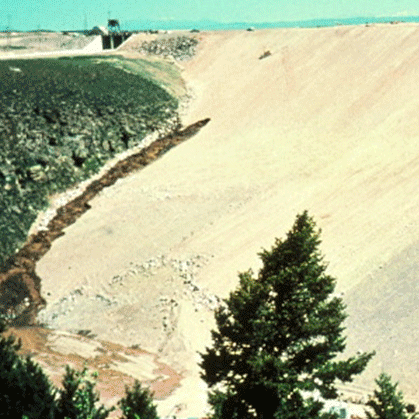
External erosion due to overtopping is the leading cause of failure in embankment dams, river dikes, and canals, surpassing internal erosion. In the context of climate change, the intensification and increased frequency of extreme events exacerbate this risk, particularly for structures whose initial design did not account for floods of the magnitude now expected.

The physical understanding of this phenomenon remains incomplete, especially for embankments with a wide range of particle sizes. Experimental characterization methods, in particular, are not yet fully developed.

To date, the most commonly used test to characterize the overtopping resistance of an embankment is the Jet Erosion Test (JET). Initially designed for cohesive soils, it does not accurately reflect the surface erosion mechanism typical of non-cohesive soils.

The Overcome/DIGAURA project led by EDF and in which geophy
Consult participates aims in particular to better understand and model the mechanisms of external erosion by overtopping of soils with spread grain size, via numerical models and physical models at small and large scale.
References
geophyConsult has carried out more than a dozen stability studies of hydraulic structures in embankments for the most important French project owners.
A pioneer, along with others and particularly EDF, in managing erosion risk in France, geophyConsult has carried out dozens of expert assessments of erosion risk for hydraulic structures on embankments, both in France and internationally, for the largest French project owners..
Diagnosis leafleft in pdf
Diagnosis leafleft

Download

Headquarters / South site
Alpes site
Find us