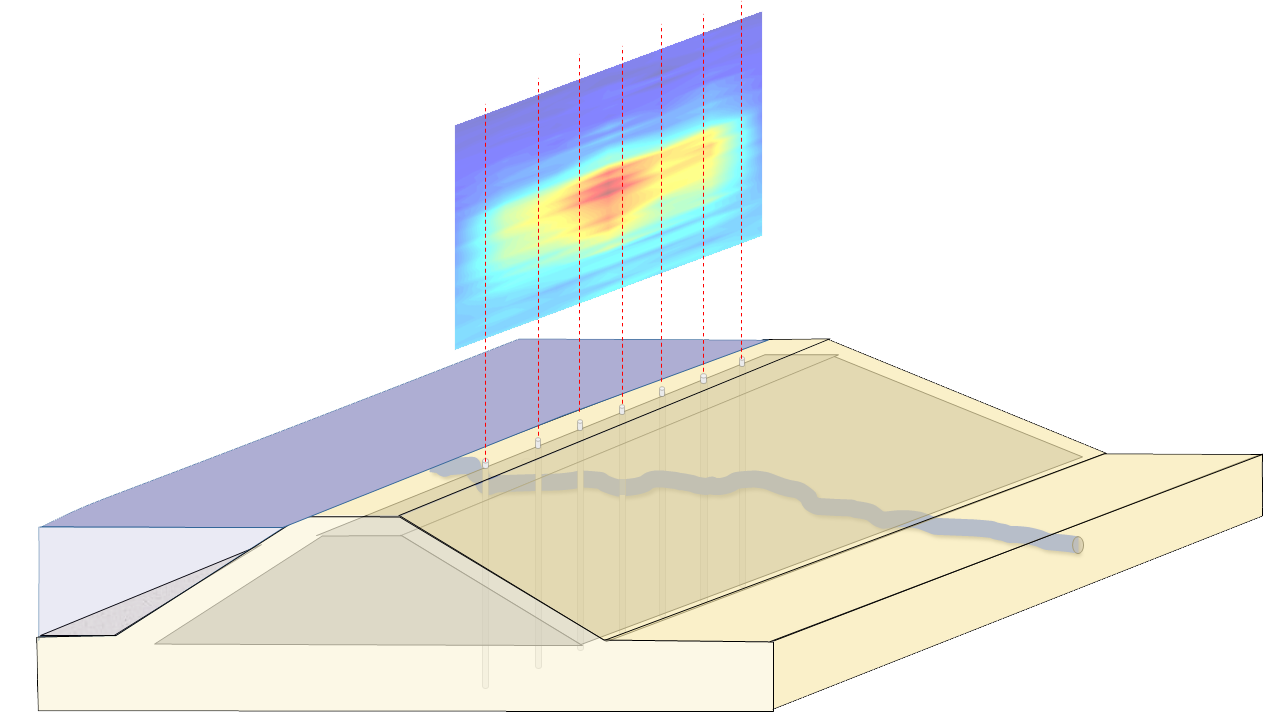

The purpose of this service is to perform, most often urgently, multiparameter mapping (temperature, mechanical resistance, etc.) of an area suddenly affected by a worrying problem (such as the sudden appearance of a sinkhole or subsidence in a critical structure). The method can also be used to monitor a problem that appears to be slowly evolving, where the structure owner needs to know, continuously and in real time, that it is not changing suddenly, or whose underlying mechanisms needs to be understood.
Principle
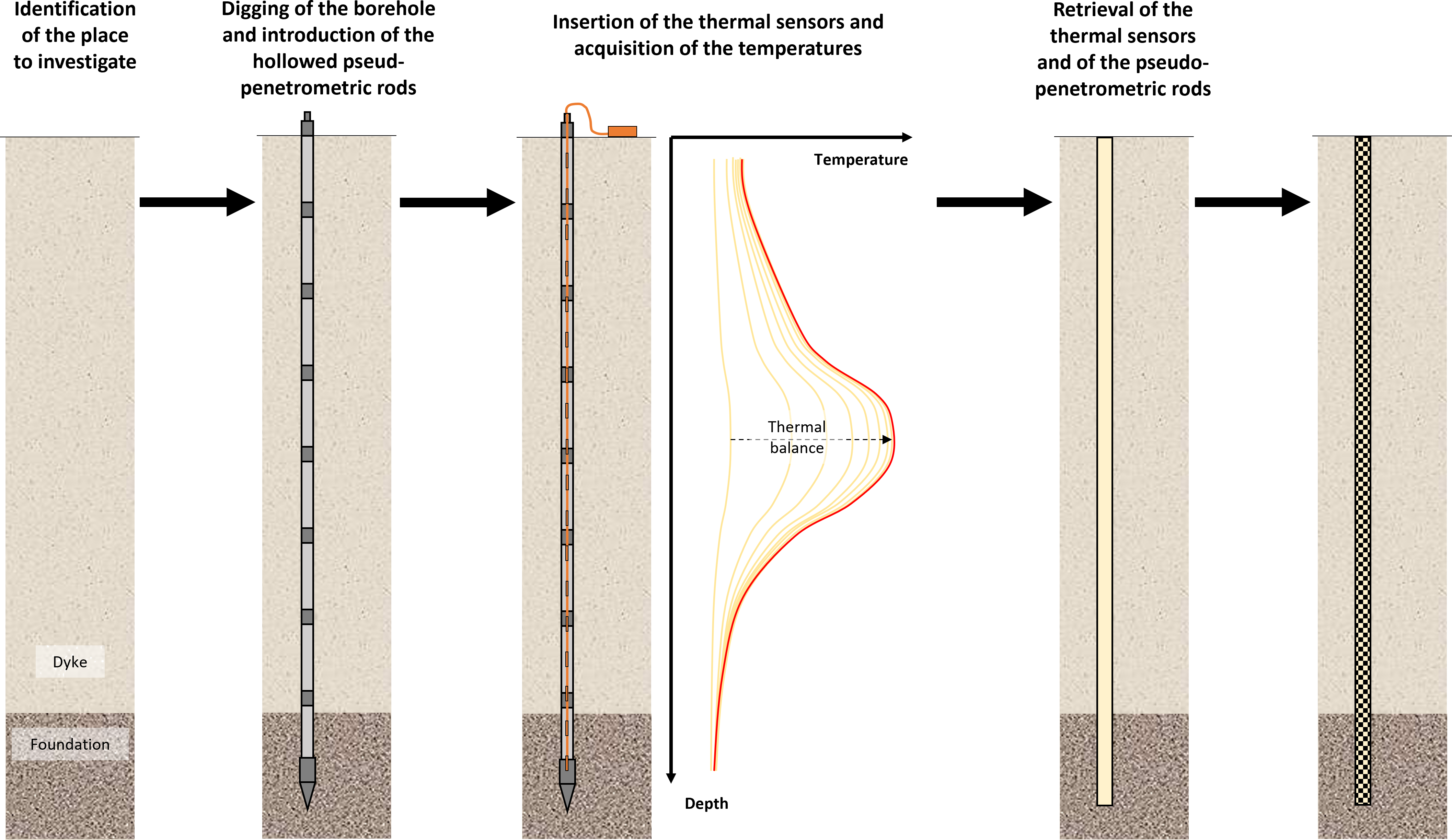
To carry out multiparameter mapping (temperature, mechanical resistance, etc.), geophyConsult mobilizes, if needed in an emergency, in the area affected by the leaks, one or more small driving drills and uses it or them to successively insert, down to the foundation (and, if possible, a little deeper), hollow penetrometer rods into which the operator inserts, as soon as the driving is complete, a chain of thermistors allowing him or her to obtain, once thermal equilibrium is reached, a vertical thermal profile and a vertical penetration resistance profile in the area affected by the disturbance.
Delivered results
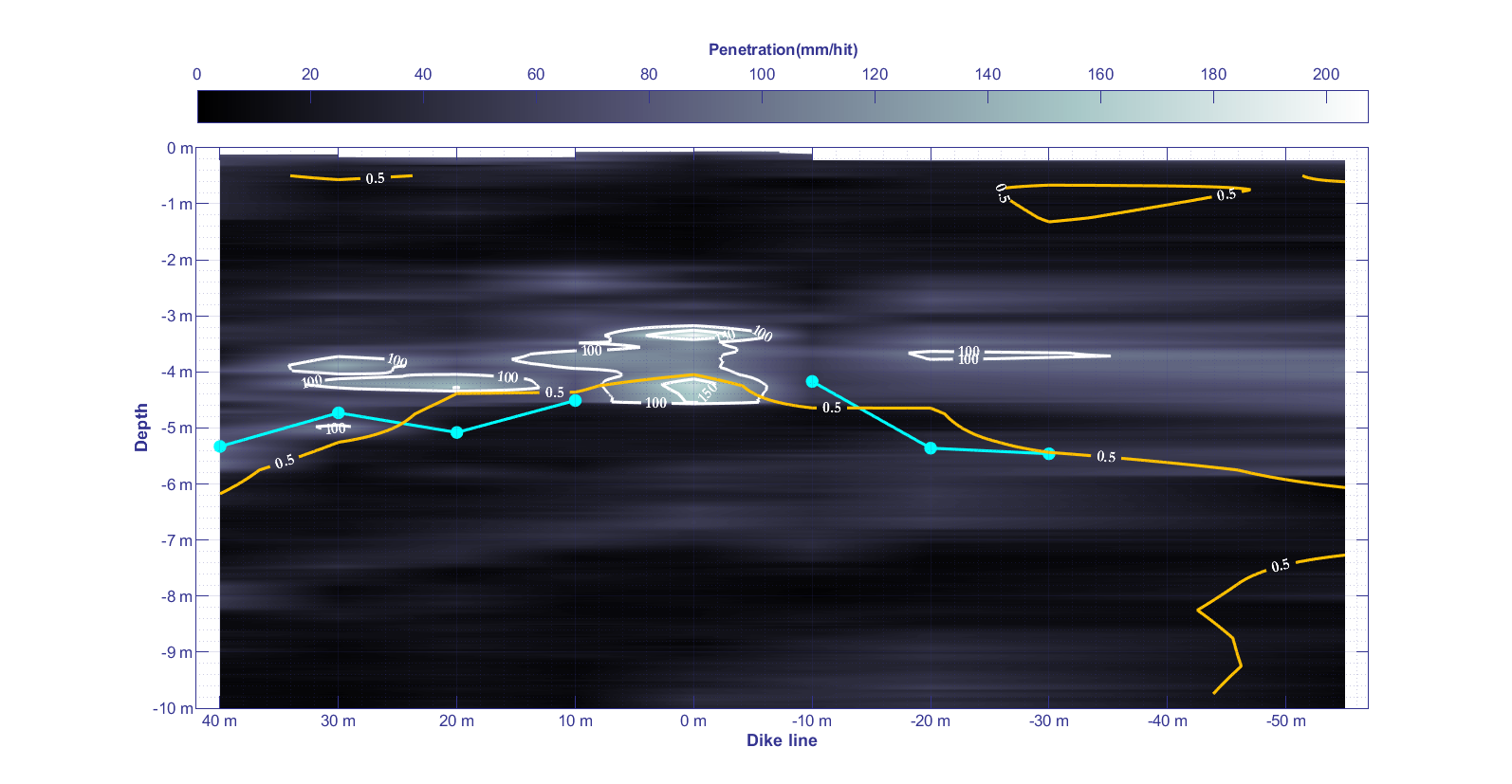
A reconnaissance campaign concludes with the production of a detailed map of a few tens of meters of linear structure, within which the extent of the area affected by the problem(s) can generally be easily delimited longitudinally and vertically.
Orange contour lines = deviation from the expected temperature in the absence of flow Gradient of black = resistance to rod penetration measured during penetrometer rod driving Blue line = water level
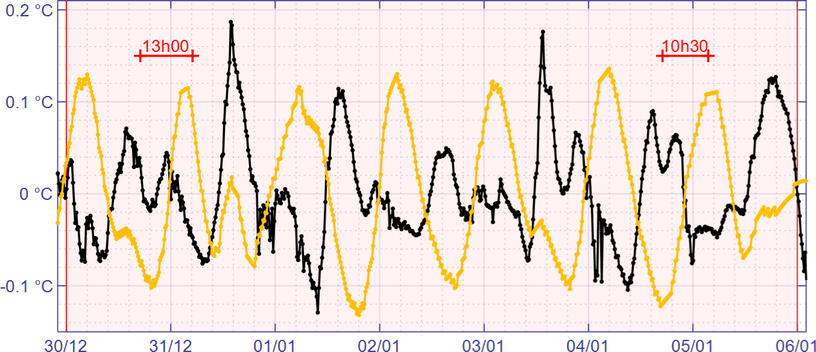
When the thermistor string from the borehole that best intersects the leak can be left on site for a few days or weeks, the method also allows for the estimation of a flow velocity. This additional parameter is often key to determining whether internal erosion is likely to be occurring within the leak – and thus requiring immediate site remediation.
The temperature of the reservoir is shown in black, and the temperature measured in a borehole intersecting the leak is shown in orange. Note the reduction in phase shift over time, indicating an increase in flow velocity associated with the disturbance
This technique implicitly assumes a measurable thermal contrast between the temperature of the upstream reservoir and that of the structure. It is therefore more effective when this contrast is high, meaning the survey is conducted in summer or winter, but not during the transitional seasons when outside and inside temperatures overlap.
In practice, the period during which the method cannot be implemented is short, at least in temperate latitudes, of the order of a few weeks only.
This mapping and any associated monitoring are acknowleged as a key decision-making tool for determining the most appropriate action to take to address the emergency or to plan suitable remediation.
References
geophyConsult has produced, sometimes urgently and across the entire country, approximately 1,000 linear meters of vertical thermal profiles of dikes exhibiting worrying or slowly evolving damage.