
Erosion of embankment hydraulic structures
Contact
✉️
Principle
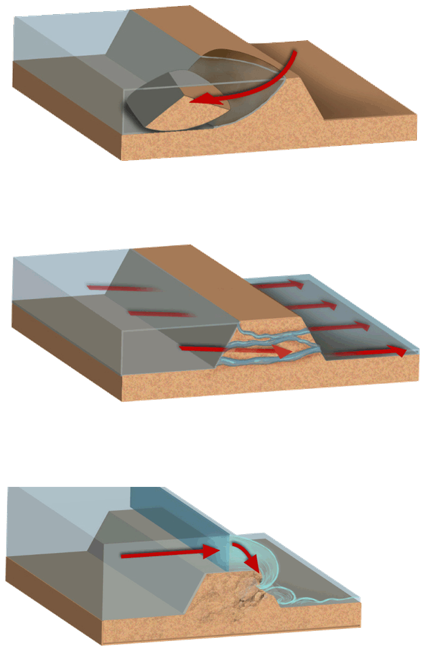
hree failure modes are known to threaten embankment dams:

  • mechanical instabilities (i.e., mechanical shear),

  • local removal of fine particles by internal flow (i.e., internal erosion),

  • removal of grains by surface flow (i.e., external erosion due to overtopping).

While no reliable statistics are available on a global scale for small dam failures, it is established that for large dams, more than 90% of failures are due to erosion (both internal and external).

The industry agrees that the vast majority of breaches in small hydraulic structures (dikes, levees, etc.) are also caused by erosion, both internal and external.

The risk of erosion is therefore a major concern for the safety of embankment hydraulic structures.

Given that this risk is all the greater when the upstream hydraulic head is higher, its importance is expected to increase in the long term. Indeed, with climate change, which will result in an increase in the frequency and intensity of extreme weather events in our latitudes, the cumulative annual number of days during which these structures are subjected to a heavy load will increase.
The value of erosion tests
Traditional techniques for diagnosing hydraulic structures do not adequately assess vulnerability to erosion.

Erosion tests aim to address this gap and quantify the erosion resistance of the soils within the structures.

They are generally performed using core samples taken during geotechnical investigations.

They are most often used within the framework of « Hazard studies » or
« Initial Safety Assessments ».

Headquarters / South site
Alpes site
Find us